
Talking trade, testing ties
Recent high-level summits have amplified the Global South’s voice in a changing world, while testing India’s diplomacy in different ways. Amit Agnihotri, reports
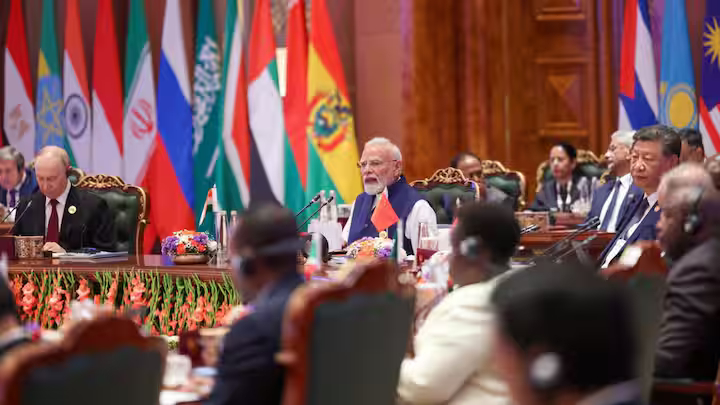
Two recent international conclaves – the Shanghai Cooperation Organisation (SCO) summit in Bishkek, Kyrgyzstan from August 31 to September 1, and the BRICS summit in New Delhi on September 12 and 13 – gave greater voice to the Global South amid a world in flux. They also, in various ways, tested the diplomacy of South-Asian major India.
These summits assumed significance as they took place against the backdrop of tensions over the Ukraine war, now in its fifth year, and the ongoing US-Israel vs Iran conflict in West Asia, which has disrupted supply chains worldwide and sent global economies plummeting.
As a group, the Bishkek Declaration reiterated the SCO’s key role in a multipolar world, discussed financial independence and insulating trade from sanctions, and endorsed regional connectivity.
While the SCO conclave offered India a chance to explore both bilateral and institutional frameworks to deepen its relations with the strategic Central Asian region, the BRICS meeting showcased bloc president New Delhi’s high stakes power balancing between the US-led West on one side, and the emerging China-Russia axis on the other.
The SCO was formed in 1996 as a security bloc by China, Russia, Kazakhstan, Kyrgyzstan and Tajikistan, to settle their border disputes. Uzbekistan was included in 2001, India and Pakistan in 2017, while Iran and Belarus became members in 2023 and 2024 respectively. Additionally, the SCO has 14 dialogue partners, including Saudi Arabia, Qatar, Egypt, Turkey, Myanmar, Sri Lanka and Cambodia.
Both China and Russia have a strong security and monetary influence among the five Central Asian Republics through the SCO, but the region is now keen to revive its age-old ties with India, which has made its mark as an emerging regional power and strong voice of the developing nations, mainly due to its policy of strategic autonomy.
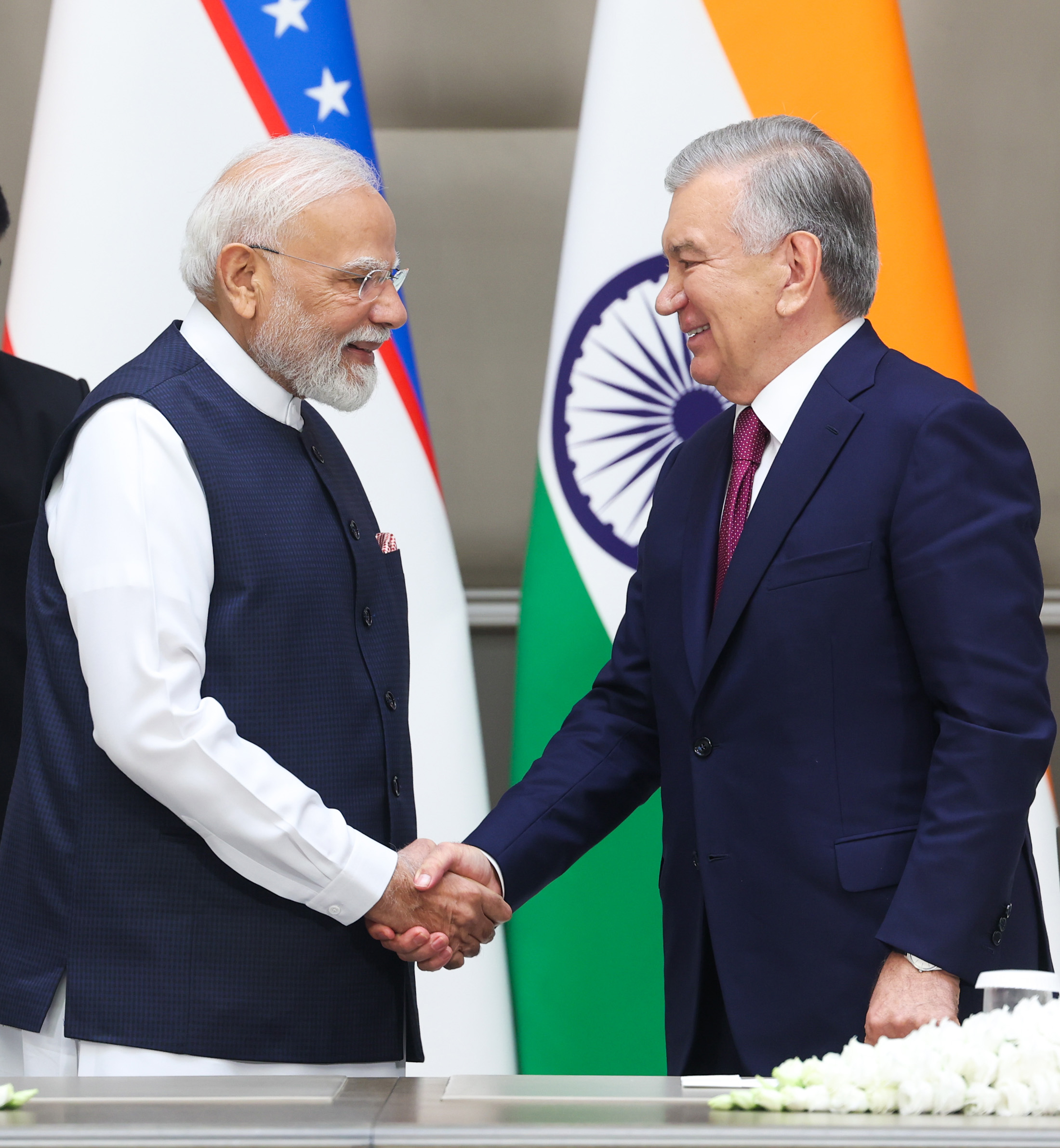
Understandably, the Central Asian nations are eager to explore new supply chains, and India comes across as a reliable and stable partner. The same reasoning works for New Delhi, which wants to curb its dependence on Western supply chains. In particular, the bilateral visit of Indian prime minister Narendra Modi to Uzbekistan ahead of the SCO conclave, to secure long-term uranium supplies and expand trade relations, served that purpose. The Central Asian countries are also keen to explore trade with India via the International North-South Transport Corridor, which will allow New Delhi access to markets in Russia and Europe as well.
The Central Asia region is now keen to revive its age-old ties with India
Besides the SCO, India also engages with the Central Asian region via multilateral forums such as the India-Central Asia Summit, which was established in 2022, and the India-Central Asia Dialogue, which focuses on stability in this strategic area.
While India was just one of the participants in the SCO conclave, New Delhi was the host and bloc head of the BRICS summit which provided an opportunity to the South Asian major to portray its diplomatic deftness by bringing group members with divergent views around a common vision statement dubbed ‘the New Delhi Declaration’.
BRICS was formed in 2006 by Brazil, Russia, India and China, with South Africa joining in 2010. The bloc has since expanded to include Egypt, Ethiopia, Iran, the United Arab Emirates, Saudi Arabia and Indonesia. Having originated as a geo-economic forum, BRICS intended to remain that way. Yetthe 2026 summit was able to make a geopolitical impression as well.
New Delhi wants to curb its dependence on Western supply chains
The US has viewed BRICS as anti-West, given that Washington’s two powerful adversaries China and Russia are members of the bloc, which described itself as a forum to flag the concerns of developing countries, often dubbed as the Global South. Within BRICS, different members have used the bloc to suit their own ambitions. A US sanctions-hit Russia had been keen to use BRICS as a forum to ease its economic woes, while China looked to assert its global superpower ambitions through the bloc.
For India, the grouping offered another opportunity to articulate its strategic autonomy, or equidistance from the US-led West, while showcasing healthy ties with Washington’s rivals China and Russia. With both Chinese president Xi Jinping and Russian president Vladimir Putin attending the 2026 summit and holding separate parleys with Indian prime minister Narendra Modi, Washington may have been tempted to look upon the conclave as an anti-US gathering.
But it was proved wrong.
For the BRICS strategists, the key challenge was to work out a declaration that spoke in one voice, as there were many sticking points within the bloc. Russia, the aggressor in the Ukraine war, would not have liked facing flak for Moscow’s misadventure in Eurasia, West Asian nations Iran and the UAE, which are on opposite sides in the ongoing US-Israel vs Tehran conflict, would not have been okay with the mention of the conflict.
As for China, which has long-standing border issues with India, it would not have been comfortable receiving suggestions from the bloc that mutual disputes and maritime differences must be resolved through dialogue rather than force. The US, of course, would not have been pleased with direct criticism of any sort on any issue.
Nonetheless, BRICS was able to achieve convergence on all these contentious issues. Accordingly, the New Delhi Declaration touched upon conflicts, terrorism, UN reform and multipolarity without leaving out a developmental agenda focusing on health, food security, energy security, technology, AI, digital public infrastructure, critical minerals, supply chains and financial cooperation.
The declaration urged restraint in West Asia in the context of the continuing US-Israel vs Iran conflict, but avoided condemning the US for attacking Tehran or censuring the Islamic nation for targeting the Gulf nations. Earlier, BRICS foreign ministers had tried to work out a joint statement over the Iran war but could not. The New Delhi declaration successfully reached that middle ground. Also, it saved India from embarrassing US ally Israel, with whom New Delhi has deep ties.
The global trade wars unleashed by US president Donald Trump did not find any mention in the document, although several BRICS members, including India, China and Russia, have faced US tariffs of late. In a vague manner, the declaration condemned unilateral tariffs, saying they worked against international law. In effect, the recent thaw in India-China ties, despite tensions over violations of the Line of Actual Control in eastern Ladakh, took place primarily due to the punitive US tariffs that were meant to deter New Delhi from buying discounted Russian oil.
For his part, Putin told Europe not to fear Russia but also warned the EU against sending troops to Ukraine. This signalling was important, as the US is unhappy with the EU for not helping it in the war against Iran, while the Atlantic allies are equally keen to move beyond America’s influence.
The SCO and BRICS conclaves were important, as the two groupings represent large populations and economic worth. The SCO accounts for around 43 percent of the world’s population and 23 percent of the global economy. The 11-member BRICS accounts for around 40 percent of the world’s gross domestic product.
How the two groupings generate greater economic benefits for their member nations in the coming months and years will be interesting to watch.
Amit Agnihotri is a Delhi-based journalist who has worked with several national newspapers and focuses on politics and policy issues