

A move towards managed rivalry
At its most recent panel debate, The Democracy Forum explored how the war in Iran has reshaped US-China relations, and how it may so far have bolstered Beijing’s strategic position
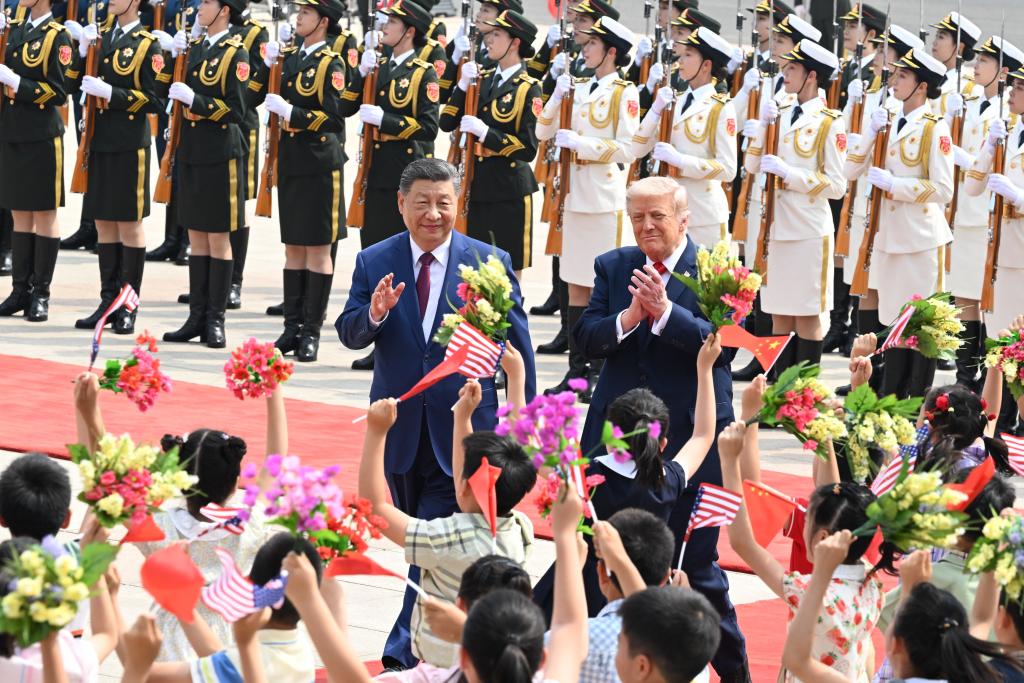
In the wake of the May 15th Xi-Trump summit, The Democracy Forum convened a timely event titled ‘After Iran: A new US-China relationship’, aimed at understanding how this bilateral relationship is responding to the shadow cast by the Iran conflict.
Lord Bruce, President of TDF, opened by noting the sharply contrasting statements from Presidents Trump and Xi after their summit in Beijing. While Trump delayed the meeting to gain leverage over Iran, the conflict was hardly discussed. The White House claimed the leaders agreed Iran should be denied nuclear weapons and the Strait of Hormuz reopened, while Beijing advocated for dialogue and caution. Analysts, as Lord Bruce highlighted, see this as a key difference: Washington seeks China’s help to resolve crises, but Beijing prefers to stay uninvolved. Lord Bruce also observed that new terminology emerged, reflecting China’s desire to discourage the US and its allies from adopting a defensive posture on Taiwan. Xi emphasised Taiwan’s importance to US-China relations, and warned of confrontation if mishandled. Yet within hours of the summit ending, Trump equivocated on a pending $14bn arms deal with Taiwan, signalling continued US support for Taiwan’s sovereignty.
Although the summit produced trade agreements, Lord Bruce cautioned that new boards for trade and investment may do little to address concerns over China’s state-subsidised industries or security risks. Ultimately, the summit signalled not a return to normal relations but a move towards managed rivalry and bilateral bargaining, with China wary of American unpredictability and hesitant to take on a larger security role. Lord Bruce concluded by citing Zongyuan Zoe Liu of the CFR, whohas observed thatUS-China relations are now ‘more transactional and potentially more unstable: managed rivalry through bilateral bargaining’, with China fearing‘American volatility more than American power’, even as ‘Beijing has limited appetite, experience and capacity to replace the US as a security provider’.
Ali Wyne, Senior Research and Advocacy Advisor for US-China Relations at the International Crisis Group, noted that although the war is testing China’s energy resilience and complicating its diplomatic ties with Gulf countries, it is, overall, more strategically advantageous for Beijing than Washington. Wyne pointed out that if the Strait of Hormuz remains closed, China’s energy resilience will face increasing pressure, but China is generally better positioned to handle short-term disruptions compared to some of America’s Asian allies. Diplomatically, China faces a balancing act between strengthening relationships with both Iran and the Gulf nations.
Nonetheless, Wyne observed four main ways the conflict benefits China: it highlights a contrast between an unpredictable US and a stable China; it distracts from US efforts to rebalance towards Asia; it increases America’s reliance on China for critical resources like gallium; and it forces US allies to accelerate clean energy transitions, which depend heavily on Chinese inputs. In sum, Wyne concluded that, despite its challenges, the war has so far bolstered China’s strategic position more than America’s.
Beijing has limited appetite, experience and capacity to replace the US as a security provider
Reflecting on China’s broader objectives and the evolving China-US competition after the Iran war, Dr Tom Harper, Lecturer in International Relations at the University of East London, observed that while the Xi-Trump summit offered few material achievements, its symbolic significance was considerable. Harper noted that this underscores how the US-China relationship can continue to be managed, and highlighted that China’s approach to the US shifted notably during Trump’s first administration, as China was initially caught off guard by the trade war.
Now, however, China appears more proactive and confident, intent on managing the relationship while advancing its 16th Five-Year Plan, which prioritises self-sufficiency. Harper explained that China regards alliances as liabilities and is keen to avoid entanglement in problems of America’s – or Trump’s – own making. He also pointed to China’s emphasis on controlling key supply chains, a strategy validated by the recent Strait of Hormuz crisis. Harper concluded that this focus on supply chain control is likely to define China’s approach to the United States in the coming years.
The Iran conflict highlights a contrast between an unpredictable US and a stable China
Dr Zeno Leoni, Assistant Professor in Defence Studies at King’s College London, also offered an insightful assessment of the Xi-Trump summit, addressing what he perceived as certain media misrepresentations. He emphasised that while the summit was important, it did not mark a historic turning point, and expressed scepticism about the concept of a G2, or dividing the world into spheres of influence. Leoni addressed two prominent issues highlighted in the media: firstly, the debate over which country is stronger, the US or China, and secondly, the notion that Trump visited Beijing from a position of weakness. Despite ongoing challenges for the US, such as the war in Iran, Leoni pointed out that recent events in, for example, Venezuela and Nigeria reinforce the view that the US remains the only country capable of projecting military power globally. However, he noted that this ability does not necessarily equate to success in warfare, which can ultimately benefit China.
Regarding the media’s suggestion that Trump travelled to China seeking assistance to resolve the war in Iran, Leoni dismissed this idea as absurd, arguing that since the US initiated the conflict, it would not seek Chinese help. He also highlighted the limitations of China’s influence beyond the Indo-Pacific region and, in conclusion, inferred that the current international order remains centred on sovereign states, which are not easily influenced, particularly regarding their internal decision-making processes.
In his closing comments, TDF Chair Barry Gardiner MP agreed that China’s five-year plan is about self-sufficiency, not about projecting its own world order, and said that defending our democracy against another country is certainly worth the fight, but to export our democracy to another country may well not be.
Among key takeaways from the debate was the belief that Iran had not necessarily catalysed a new US-China relationship, buthas underscored an evolving one in which China feels itself to be a more capable competitor and the US has gained a more realistic appreciation of China’s power.
MJ Akbar is the author of several books, including Doolally Sahib and the Black Zamindar: Racism and Revenge in the British Raj, and Gandhi: A Life in Three Campaigns
To watch the full discussion, tune in to