
The technocratic trap at India’s doorstep
Y.S. Gill offers an Indian reading of Nepal’s new order, the Beijing factor and the looming shadow of the West
Seen from New Delhi, Nepal is not just a foreign country. It shares a 1,750-km open border with five Indian states, its citizens work freely in India under the 1950 Treaty of Peace and Friendship, and Gorkha (Nepalese) soldiers serve in the Indian Army. No wonder, then, that the rumblings in Kathmandu can be felt not only in Bihar, Uttar Pradesh (UP) and Uttarakhand, which share common ethnic lineage, but also in the power corridors of New Delhi.
The ‘Gen Z’ uprising of September 2025 – led by people born between 1997 and 2012 and triggered by a ban on social media – left at least 76 dead and toppled Prime Minister K. P. Sharma Oli. In elections on 5 March 2026, the Rastriya Swatantra Party won 182 of 275 seats. Its leader, former Kathmandu mayor Balendra ‘Balen’ Shah, beat Oli in his seat and was sworn in on 27 March as Nepal’s youngest elected prime minister and the first from the Madhes, the southern plains whose people share language and kinship with Bihar and UP, in particular.
His supporters promised a ‘start-up state’: a lean, tech-driven government run on targets, like a new corporate entity. Six months on, that idea has collided with governance, disaster and the India-China rivalry. For India, Kathmandu’s experiment is becoming a strategic question mark.
Nepal’s party labels mislead outsiders. The ruling Rastriya Swatantra Party (RSP, ‘National Independent Party’), founded in 2022 by former TV host Rabi Lamichhane, is centrist and anti-establishment, driven by anti-corruption populism with no settled tilt towards India or China.
The Communist Party of Nepal (Unified Marxist-Leninist), or CPN-UML, is Oli’s party: communist in name, nationalist in practice, and seen in Delhi as closest to Beijing. The centre-left Nepali Congress has historically been closest to India. The far-left Maoists under Pushpa Kamal Dahal ‘Prachanda’ swing between the two. The right-wing Rastriya Prajatantra Party wants the monarchy and a Hindu state restored.
On the American side, the National Endowment for Democracy (NED) is a Congress-funded non-profit that promotes democracy abroad. Its core institutes, the International Republican Institute (IRI) and the National Democratic Institute (NDI), are tied to the two US parties. With the non-partisan International Foundation for Electoral Systems (IFES), they form the Consortium for Elections and Political Process Strengthening (CEPPS), funded mainly by USAID, the US aid agency. The Grayzone, which published the leaks, is a left-wing, anti-interventionist US outlet that critics accuse of echoing Russian and Chinese positions.
Shah promised ‘delivery-based governance’ and a 100-point reform agenda: fewer ministries, fewer approval layers, digital services and a depoliticised civil service. On the 100th day, his spokesperson claimed 87.2 per cent implementation of the agenda.
India felt the most direct fallout from the regime change in April
The ground picture is thinner. Reforms have stalled due to court orders and bureaucratic resistance. Despite a near two-thirds majority, the Civil Service Bill, promised within 45 days, was still being drafted although six months have passed. Without a party machine, the cabinet governs through dashboards and deadlines, and the permanent bureaucracy has learned how to outwit it. Even sympathetic commentators, such as Deepak Thapa of the Kathmandu Post, now warn of centralised, impulsive decision-making reminiscent of the Oli style of governance.
Bhotekoshi flood: the government’s first real test
Until August, Shah was judged only on reform targets. The Bhotekoshi flood was his first serious emergency and the first real test of whether a government of newcomers could handle a crisis.
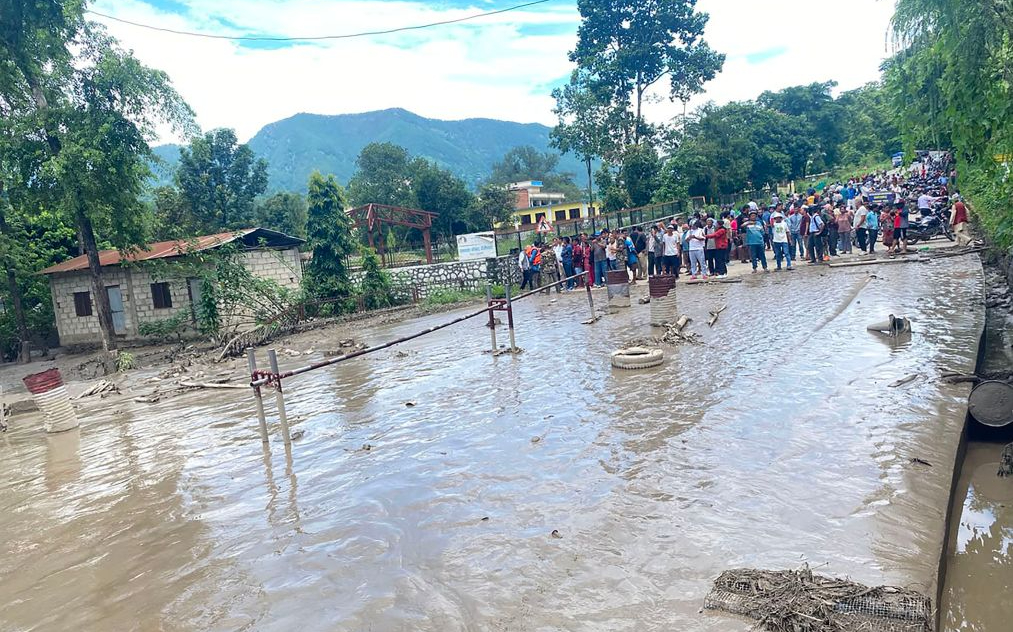
The Bhote Koshi is a Himalayan river flowing from Tibet into Nepal’s Rasuwa district. On 26 August, a glacier collapse near the Tibetan border triggered a deadly debris flood down downstream. It swept away the border town of Timure, the Chinese-contracted 111 MW Rasuwagadhi hydropower plant and the Timure dry port on the Kerung road, the trade route Beijing promotes as Nepal’s alternative to India. The police have recorded well over 1,400 deaths by late September, making it the deadliest natural calamity on record in Nepal.
As prime minister, Shah has conveyed conflicting messages
The army’s rescue work drew praise, but Kathmandu turned away foreign rescue teams while hundreds of foreigners were missing. At the UN General Assembly on 24 September, Shah demanded grants, not ‘another mega loan’, and proposed a Himalayan climate mechanism led by Nepal, India and China. Delhi should take it up: floods from Tibet flow towards Bihar.
India felt the most direct fallout from the regime change in April, when Kathmandu began strictly enforcing a dormant rule imposing customs duty on goods worth over NPR 100 (£0.488) brought from India. Nepal’s Armed Police Force searched shoppers’ bags for sugar, rice and oil brought from the Indian side of the border.
Curbing revenue leakage was a fair aim; the execution was not. Sunauli shopkeepers on the Indian side reported Nepali footfall down by three-quarters, border markets in Bihar and Uttarakhand emptied, and protests spread through the Madhes that had just elected Shah. To many Indians, this situation recalled the 2015 blockade in reverse, when Madhesi protests choked supplies and Kathmandu blamed Delhi for not allowing essential goods into Nepal.
Between Delhi and Beijing
Shah inherited a country that had drifted north. In December 2024, Oli had made Beijing his first foreign visit and signed the long-delayed Belt and Road Initiative (BRI) Cooperation Framework with China. This moved key infrastructure proposals – such as cross-Himalayan transmission lines and rail surveys–from theoretical agreements to formal bilateral commitments, solidifying Beijing’s economic footprint in northern Nepal. Earlier, in 2020, Oli’s government had demarcated Kalapani, Lipulekh and Limpiyadhura, territory that India administers, as a part of Nepal on the official map.
Shah’s history provides Delhi with sufficient reason to proceed cautiously. As Kathmandu mayor, he had in 2023 hung a ‘Greater Nepal’ map in his office, a reply to the Akhand Bharat (‘Undivided India’) mural in India’s new Parliament, depicting the cultural influence of the ancient Maurya Empire across modern-day South Asia. He also briefly banned all Indian films in Kathmandu’s theatres because a Bollywood epic Adipurush had described Sita, who is believed to have been born in Janakpur, Nepal, as a ‘daughter of India’.
Treating India, China and the US identically looked principled but left all three unsure who speaks for Kathmandu
As prime minister, he has conveyed conflicting messages. His government dropped the disputed map from a new coin, and his party chairman and foreign minister visited Delhi before going to Beijing. Yet he declined to receive Foreign Secretary Vikram Misri in May and met the Indian and Chinese ambassadors only in August, on the same day, India first and then the Chinese counterpart.
Beijing is no happier. It complains of lax vigilance over Tibetan exiles, stalled projects and a circle around Shah ‘trained under Western programmes’. That is India’s opening. India accounts for about two-thirds of Nepal’s trade, and after the flood, Nepal made emergency arrangements to import 1,154 MW of Indian electricity to avoid power shortages.
The Grayzone leaks
The second blow was dealt by The Grayzone, which published leaked details of US-funded programmes that helped groom the activists and politicians who swept Shah into power. In December 2025, Kit Klarenberg published leaked files showing that IRI, with NED money, ran a $350,000 youth programme in 2021–22 that offered training in organising protests. In September 2026, he and Wyatt Reed reported that CEPPS ran a $20 million project, Niti Sambad (Policy Dialogue), from 2017 to 2022 to build ‘next-generation leaders’ and claimed that Shah and Lamichhane were groomed as part of this programme.
Here one needs to be cautious. The programmes were real, but they ended three years before the uprising in Nepal. The honest verdict is narrower than ‘regime change’. The anger at a corrupt, ageing elite was home-grown; American money simply helped build the skills and networks that turned it into votes. Washington did not invent the grievance; it helped furnish the megaphone. For India, wary of foreign-funded NGOs at home, the precedent matters more than the nuance.
Balen Shah’s dilemma
Every move that proves Shah’s independence to one support base costs him another. Shah’s brand, which is built on opposing powerful neighbours, faces a challenge because it is built on opposing powerful neighbours, yet Nepal relies on India for rebuilding, maintaining electricity, and feeding its border districts. Any warmth towards Washington, including infrastructure grants from the Millennium Challenge Corporation, a US aid agency, feeds the claim that he is a Western project. Similarly, a lurch toward Beijing would alarm Delhi and his own young voters.
Treating India, China and the US identically looked principled but left all three unsure who speaks for Kathmandu at a time when he needs their help and money for the reconstruction of his country. To move about diplomatically, he needs to seek the help and advice of the very parties and bureaucrats he has spent his career attacking. The only way out is equal engagement rather than equal distance: an early visit to Delhi, a working channel to Beijing, and full transparency over foreign grants to Nepali civil society.
New Delhi’s options
Nepal is the third neighbour in four years, after Sri Lanka and Bangladesh, to see a government fall to street power. India cannot afford instability on a border with no fence and no visas. Delhi should resist two temptations: treating Shah as another Oli and assuming a new guard in Kathmandu automatically serves an anti-China design. A weak government suspected of foreign sponsorship invites pressure from every side, Beijing’s included.
The better course is generous engagement. Answer Shah’s UN appeal with reconstruction grants before China does. Join his Himalayan climate proposal. Settle the customs dispute through a joint mechanism, not retaliation. Deepen power trade. Oppose third-party political engineering in the neighbourhood, whether it comes from Washington or Beijing. A stable, sovereign Nepal that trusts India serves New Delhi’s interest far better than a proxy arena where India is one of three bidders.
YS Gill is a political analyst