
Another tsunami sweeps Sri Lanka
Another tsunami sweeps Sri Lanka
Neville de Silva reflects on the recent events – and one key figure – that have dramatically altered the island nation’s political landscape
It was Christmas time in Sri Lanka, the morning of 26 December 2004. The country’s minority Christian community and those from other communities were preparing to leave by coastal trains and other means, heading for the south and other tourist destinations for a fun day by the sea.
Then it happened –suddenly, unexpectedly. Huge waves swept on to the shores, carrying with them whatever was in their path: seaside homes, hotels, places of entertainment not yet open for the day. Buses, cars and other vehicles were washed off the streets, along with their passengers and thousands of holiday makers who had ventured into the sea in the Southern Indian Ocean.
Such was the sheer power of the water that a train-load of travellers close to the beach was swept many metres, killing or injuring thousands. Elsewhere, in several coastal provinces, particularly along the south, southeastern and eastern coasts, people and animals from nearby forest reserves perished.
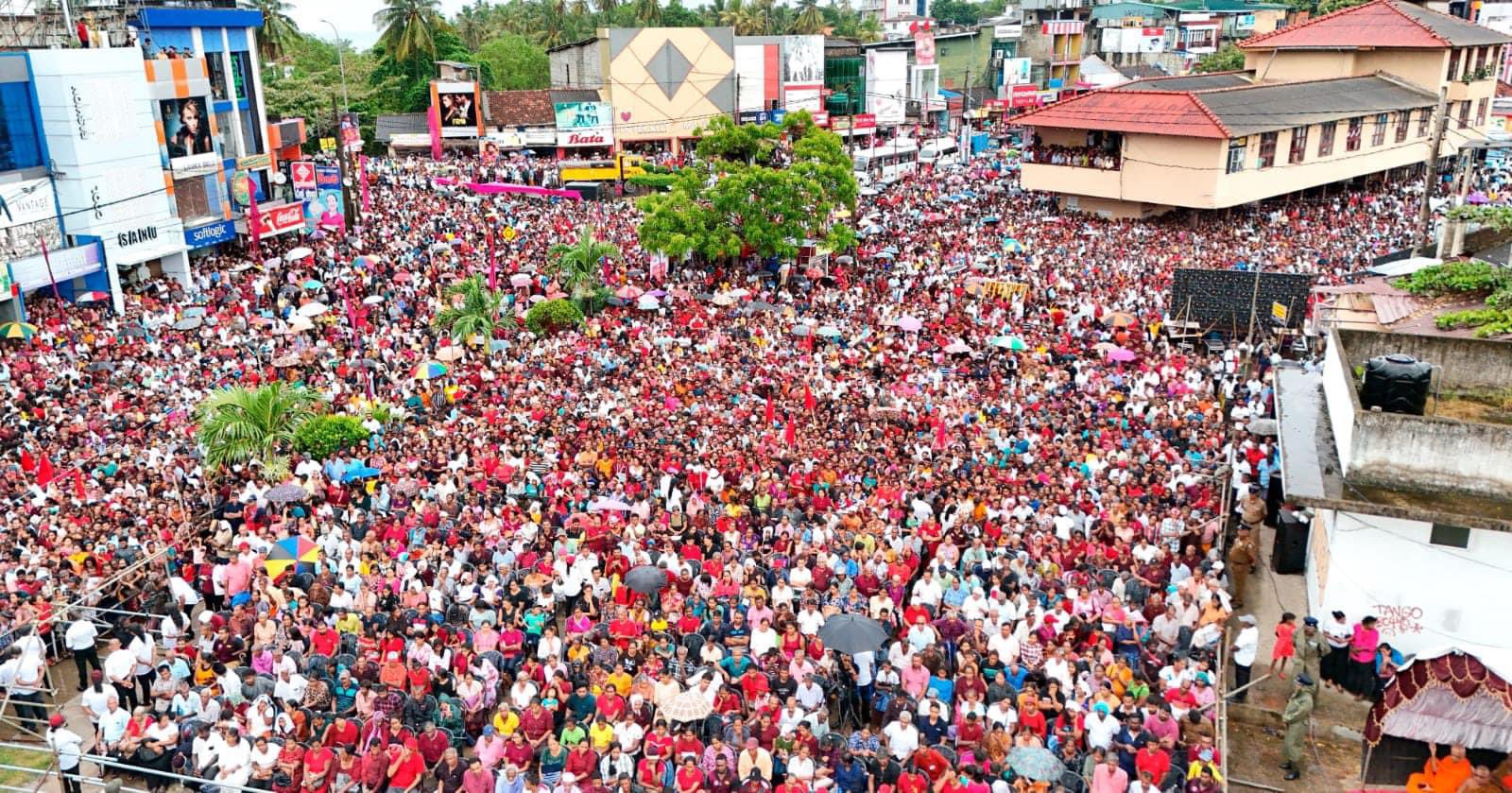
If nature struck in December 2004 in a devastating Asian tsunami that spread as far as the African coast, almost 20 years later it was a tsunami of a different kind that engulfed Sri Lanka.The political tsunami that shook the island nation on 14 November 2024 is one whose repercussions will continue to reverberate at home for some time to come.
Yet this time, the country’s 22 million people had the franchise to decide their future.They were not victims of tectonic plates in the Australian-Indonesian waters, forced to surrender to geological events.
Like its 2004 predecessor, the tsunami of 2024 took Sri Lanka by surprise. It caused a tectonic shift in the country’s post-independence political landscape and traditional ways of governance, as it was aimed at dispensing with the corrupt old guard. The November 14 parliamentary election uprooted the long surviving ruling class and the comprador capitalism of the old political parties that had dominated Sri Lanka’s politics since independence in 1948.
But if the 2004 tsunami was geological and physical in nature, and the damage it wreaked was internal, this one was essentially political and its impact was felt not only in Sri Lanka and neighbouring nations, but also far beyond, particularly in the Western world – though for different reasons.
November’s election was won by a political alliance formed just a few years earlier, which swept aside Sri Lanka’s major parties that had dominated politics for over 60 years. And on its way to gaining power, it made history.
This is not only because the alliance won 159 seats, an unprecedented majority of over two-thirds of the seats in a 225-member legislature – the first time this has happened since the introduction of proportional representation decades ago.
Nor is it because it won 21 of the country’s 22 district constituencies; nor even because it was the first Sinhala-Buddhist party from the country’s south to win parliamentary seats in the predominantly minority-Tamil constituencies in the north (including the Tamil heartland of Jaffna, the east and the mainly Tamil plantation areas in the central hills), defeating long-established Tamil political parties that perpetuated Tamil nationalist politics.
For the first time in its history, Sri Lanka has a government led solely by a Leftist alliance
This nascent election king-maker that made political history in November was a Left-leaning alliance of small political parties, trade unions, civil society organisations and activists named the National People’s Power (NPP). It threatened to oust the decaying and corruption-ridden politics of the past and implant an entirely new system of governance.
Today, for the first time in its history, Sri Lanka has a government led solely by a Leftist alliance.
The NPP that emerged as a political party in 2019, led by Anura Kumara Dissanayake, (popularly called AKD), a member of one-time Marxist party Janata Vimukthi Peramuna (JVP- People’s Liberation Front), which he had joined as a student, contested the presidential election that year but gained a paltry 3 per cent of the vote. The following year, the NPP managed to scrape together three seats in the 225-member legislature.
The party was scornfully nicknamed by its rightist parliamentary opponents and critics as ‘3 per cent’ for its poor showing at both elections, which swept into power the Rajapaksa clan, the country’s most powerful political family, with one sibling as president, another as prime minister and still another as finance minister.
Yet in a remarkable change of events that shook the country’s political establishment, a party that only five years earlier had been derided and dismissed as a minor nuisance has risen to the pinnacle of power.
The NPP’s opponents label them as violent Marxists. But its capturing of executive and legislative power with relative ease in an unforeseen peaceful democratic transformation has resonated in nearby countries, some of which face civil upheavals at home.
It is this transmogrification of an alliance virtually discarded by voters five years earlier as a political nonentity which has reduced to virtually zero long surviving parties with seasoned leaders and politicians. When the nation awoke the next morning to the news, it seemed like a fairytale.
Although the JVP was the hardcore party at the centre of the now emerging NPP led by Dissanayake, a progressive socialist determined to transform Sri Lanka into a people-centred democracy, 20-odd other organisations that formed the NPP were inclined to follow the Dissanayake ideology.
The NPP has been calling for the abolition of the executive presidency and a return to the parliamentary system
In 2022, mass public protests against the government of Gotabaya Rajapaksa, younger brother of an earlier president Mahinda Rajapaksa, were instrumental in ousting him. People took to the streets to demonstrate against his policies, which had led to shortages of food and domestic essentials like fuel.
It was a grand opportunity for the progressive democratic NPP, which has been calling for the abolition of the executive presidency and a return to the parliamentary system, to join the ‘Aragalaya’ (protest movement) and establish its credentials as a people’s movement determined to dispel the old order and build a new Sri Lanka.
How the AKD-led NPP crashed its way to democratically elected power after having a hand in two insurrections is now history and does not need to be retold, because Sri Lanka hastaken several steps forward to change the country’s socio-political landscape.
It is now eight months since Anura Kumara Dissanayake was installed in power, or rather installed himself in power.Where Sri Lanka will be heading in the coming years is very much the talk of a still shaken people as the NPP government grapples with the IMF, the international monetary agency with which the new regime has still not completed its negotiations to clean up former policy approaches.

That in itself is strange because, at the height of the presidential and parliamentary election campaigns, President Dissanayake and his party said they would not engage in hard negotiations with the IMF, whose diktats were too pro-Western for its liking and did not suit the NPP’s socialist-Marxist philosophy.
Those who read some of the Indian media and Western news reports at the time will not forget how they came to name the NPP as the country’s Marxist government, and continue to do so. However, over 60 per cent of Sri Lankan voters turned their backs on these nightmare visions, whether they came from local political leaders and their loyal press, the Indian or Western media, which was likely hoping for a return of pro-Western politicians and the continuation of corrupt regimes.
They now fear that the NPP will pursue the corrupt and bring them to justice for robbing state assets, as it has promised to do. Indeed, that seems to be happening now, with former high-flying politicians or their minions being questioned and arrested on charges of bribery and corruption.
While these investigations into corruption are being hastened, to the pleasure of the people who thought the NPP’s campaign promises of harsh crackdowns were mere propaganda, there is another aspect to AKD’s policy platform that is beginning to worry foreign policy analysts and thinkers.
From its inception, when the JVP was led by its supreme leader Rohana Wijeweera, and more so when India sent troops in 1987 as peace keeping forces, the JVP was strongly anti-Indian and more pro-China, in keeping with its Marxist-Leninist ideology.
However, as the tussle for power intensifies in the increasingly vital Indian Ocean, where maritime interest in the Indo-Pacific growsamong major powers such as China, India and, further afield, the US and its allies bring more sea power into the region, Sri Lanka is becoming wary as it wonders which way Colombo will turn in the coming months.
Neville de Silva is a veteran Sri Lankan journalist who held senior roles in Hong Kong at The Standard and worked in London for Gemini News Service. He has been a correspondent for the foreign media including the New York Times and Le Monde. More recently he was Sri Lanka’s Deputy High Commissioner in London
News has just come in that a member of the independent Election Commission, Ms PMS Charles, has resigned. The reason for her resignation is not known but speculation in Colombo is that she was pressured to quit in further moves to scupper the election. It is also being said that one or more of the surviving three members will also resign as pressure mounts. This could happen by independence day