
Democracy in the digital age
Democracy in the digital age
A recent Democracy Forum webinar delved into both the potential benefits and obstacles facing democratic systems amid the relentless rise of artificial intelligence
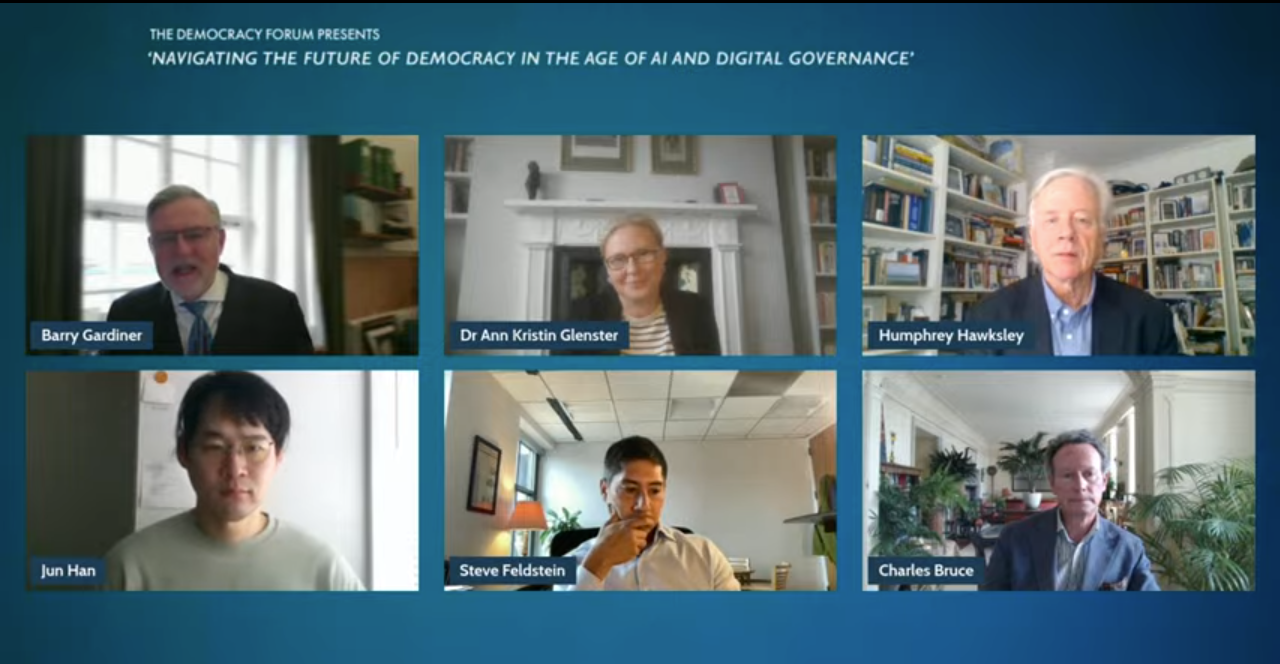
As artificial intelligence continues to advance and digital technologies become increasingly integrated into societies worldwide, democracies face both unique opportunities and significant challenges. To discuss these critical issues, The Democracy Forum convened a panel of experts for a virtual seminar titled Navigating the Future of Democracy in the Age of AI and Digital Governance’.
Lord Bruce, President of TDF, introduced the event by setting the stage for a thoughtful exchange on the intersection between cutting-edge technologies and democratic norms. There is little doubt, he said, that the widescale adoption of Generative AI has now permeated the political sphere around the world: an election database collated by the Swiss-based International Panel on the Information Environment (IPIE) reveals that in 2024 AI was used in four out of five ballots in 50 countries. Almost half of the incidents reported had no known source, while 70% were described as having harmful electoral consequences. Lord Bruce also referenced US Vice-President JD Vance’s thoughts, expressed at the AI Action Summit in Paris in February, on the existential issue underlying the control and regulation of AI, with Vance suggesting that the competition for technological ascendency has now displaced the obligation of governments to regulate its misuse and inevitable social harm.
Highlighting some of these concerns was Dr Ann Kristin Glenster, Executive Director at the Glenlead Centre and Deputy Director of the Minderoo Centre for Technology and Democracy at the University of Cambridge. She said that 80% of countries had seen election interference through digital media, and 90% of that was content manipulation and hyper-targeting, which is going to increase tremendously. This means that we have a online digital space flooded with misleading information about elections.
Dr Glenster also touched on generative AI deep fake cloning, saying that we can no longer tell what is true or not. This leads to a sort of disorientation, as people do not trust even real news or true information because they cannot tell the difference between the two.
We can no longer tell what is true or not
Dr Steven Feldstein, Senior Fellow at the Democracy, Conflict and Governance Program at the Carnegie Endowment for International Peace, argued that while artificial intelligence does not inherently drive political systems toward democracy or authoritarianism, the embedded design characteristics within AI technologies pose considerable risks of authoritarian or illiberal acceleration. According to Feldstein, AI systems can amplify the repressive actions of leaders already predisposed to illiberal or questionable agendas, as well as militaries conducting operations with dubious legality.
He cited recent empirical examples, such as the mass firings and reorganisation in the United States, with the use of AI tools by the Department of Government Efficiency (DOGE) to facilitate mass personnel changes during the Trump administration, a topic Feldstein recently explored in a coauthored article; and AI targeting in Israel, as the deployment of AI-powered targeting systems by Israel’s defence forces resulted in a significant increase in civilian harm both in volume and scale. Feldstein emphasised that in these scenarios, authorities with an established inclination towards repression or illiberal actions were able to rapidly expand their efforts through AI, often with minimal oversight or checks.
‘India is the only country that believes in both a multipolar Asia and a multipolar world’
Approaching the topic from a more optimistic perspective was Sung Jun Han, a Doctoral Candidate in Philosophy at Vanderbilt University and an AI Scholar at the Vanderbilt Lab for Immersive AI Translation, who discussed how AI could be harnessed to strengthen democratic practices. Han focused on the positive potential of AI to aid individuals and institutions in making more informed and effective decisions, as well as highlighting the ways in which AI can benefit democracy, and focusing on the potential applications of AI that could help people make better decisions.
Since democracy requires the public to be informed on many complex and fast-moving issues, AI processing skills can be helpful
Han spoke of the five expectations of democracy, including inclusion, equality and liberation Given these expectations, he pondered what types of AI agents can be used to help citizens become well informed about political issues. To answer this, he added, we have to see why AI is considered for democratic decision-making. It can process data much faster and better than humans and, since democracy requires the public to be informed on many complex and fast-moving issues, AI processing skills can be helpful for the cognitive function of citizens.

The webinar concluded with remarks from Democracy Chair Barry Gardiner MP, who posed the question: if everybody can see exactly what we’re doing and why we are doing it, are we constrained by that very fact? He spoke of how the EU has adopted a very centralised, risk-based and legally binding approach to regulation that aims to set standards for safe and ethical use of AI, and remarked on how the danger with us all having access to so much information these days is that we will actually choose only the one that reinforces our existing biases.
MJ Akbar is the author of several books, including Doolally Sahib and the Black Zamindar: Racism and Revenge in the British Raj, and Gandhi: A Life in Three Campaigns
To watch the full discussion, tune in to